Showing posts with label POINTS BEYOND. Show all posts

Monday, September 21, 2026

Don’t Dis’ Düsseldorf, Germany: 6+ Artsy & Cool Reasons To Visit


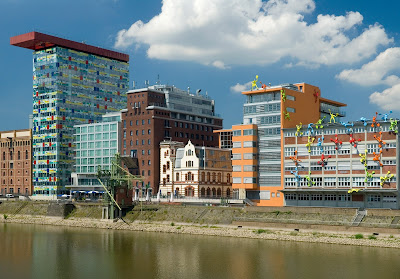
Gehry's Neuer Zollhof, Media Harbor (photo:  U.Otte,
Düsseldorf Marketing&Tourismus GmbH)

By Jacquelin Carnegie 
– (Düsseldorf, Germany)
While considered by many as a business destination, Düsseldorf should really be on the vacation list for anyone who loves art and architecture. Situated on a lovely stretch of the Rhine River, it has fabulous museums, great architecture, and famous beer. While founded in 1288, some 700+ years ago, Düsseldorf is as hip as they come--another great reason to visit now!

1) Stunning “Starchitecture”

 Media Harbor (photo: JCarnegie)
Düsseldorf’s old Rhine harbor has been transformed into Media Harbor, a trendy residential and business area for creative industries--advertising, art, and media. Several top, international architects designed buildings for the area. Frank Gehry’s magnificent Neuer Zollhof will knock your socks off as will William Alsop's stunning Colorium, on the other side of the Rhine. In addition to the “starchitecture,” there are lots of cool restaurants and bars in this revitalized district.

2) Marvelous Museums
The world-famous, art academy Kunstakademie is here, so Düsseldorf is full of talented, emerging artists as well as several outstanding museums (Kunst means art):

Hetjens Museum (©Düsseldorf Marketing & Tourismus GmbH)
Kunst Palast: Old masters, contemporary art, and a world-renowned glass collection
K20: 20th-century masterpieces
K21: Cutting-edge, contemporary art of the 21st century
KIT (Kunst im Tunnel): A unique exhibit space for emerging artists
Hetjens Museum: An incredible ceramics collection

3) The Fusion of Art & Architecture

Langen Foundation  
(photo: Dirk Topel Kommunikation ©Deutsche Zentrale für Tourismus)
In addition to the many museums, there are two unique places to view art that should not be missed:
Langen Foundation: Internationally-renowned architect Tadao Ando designed a stunning museum to house a unique Japanese art collection as well as changing exhibits of contemporary art.
Insel Hoimbroich: Art pavilions in a nature preserve. The tours are lead by artists; you can also have lunch in their wonderful café.

4) The Art of Beer

Altstadt (©Düsseldorf Marketing & Tourismus GmbH)
After all that museum-hopping, relax over a cold brewski. Düsseldorf is famous for a particular kind of beer, Altbier, which is top-brewed, copper-colored, and tart with a distinctive hops flavor. The best place to taste test it is in Altstadt (Old Town), a charming, part of the city with a lively stretch of some 260 bars and restaurants, known as the "longest bar in the world."

5) The Art of Shopping
(©Düsseldorf Marketing & Tourismus GmbH)
Fashionistas rejoice. Düsseldorf is as well known as Milan, Italy for fashion fairs and collection premieres. You can do some designer shopping along the lovely, tree-lined boulevard Königsallee at these boutiques: Armani, Gucci, Kenzo, JOOP, Prada, Jil Sander, Uta Raasch, Burberry, Onofri, Féraud and discover some Düsseldorf originals such as Sabine Schumacher, Peter O. Mahler, and Renate Harvan.

6) Dine in Glass Houses

Colorium & “Floosies,” Media Harbor (photo: Jochen Keute ©Deutsche Zentrale für Tourismus)

People in glass houses shouldn’t throw stones, they should have lunch or dinner. Enjoy a tasty meal in one of the all-glass restaurants along the Rhine riverside: KIT Cafe or the Lido with a view of Media Harbor.

Where to Stay:

Insel Hoimbroich (photo: Tomas Riehle ©Stiftung Insel Hombroich
)
There is every conceivable type of accommodation in Düsseldorf, why not try an artsy hotel: Stage47, Graf-Adolf-Strasse 47, www.stage47.de
Getting There:
Delta & Lufthansa have connecting flights from several US gateways & Berlin. Direct flights from the US: Condor from New York (JFK) and good news: Starting in Spring 2027, the all-business-class La Compagnie will fly nonstop from Newark (EWK).
In Germany, there’s an excellent train network between cities; you can even get your tickets before you leave through RailEurope.

Tuesday, September 1, 2026

10+ Artsy & Cool Reasons To Visit Marseille, France

By Jacquelin Carnegie 
Marseille Vieux Port (photo: Nigel Young)
Fort St Jean (photo: JCarnegie)
Marseille is one of the oldest cities in France with a fascinating history. As a port town, it's a melting pot for people from all over the world. However, it had gotten a bit rundown. But, when Marseille was named the European Capital of Culture, the town was spruced up nicely. Many neighborhood renovation projects were undertaken, several new hotels opened, and MuCEM, a beautiful new museum, was constructed. The buzzword for the new, improved Marseille is: "Euro-Mediterranean capital." And, with its mild climate, it's definitely worth visiting any time of year.
 
DISCOVER FASCINATING NEIGHBORHOODS
Each of Marseille's many neighborhoods has its unique charm. Discover the city on your own or take inexpensive guided tours offered by Marseille's tourism office (most are in French--good practice--but a few are in English as well). Be sure to check out these areas:
Vieux Port (The Old Port): The beautiful Vieux Port is the heart of the city, surrounded by cafes and restaurants serving traditional Marseille specialties and freshly-caught fish. Take a stroll along the pedestrian walkways and marvel at all the sailboats anchored in the harbor. 
Le Panier (The Old Town): Wander through the steep, winding, narrow streets of the oldest part of town and soak up the atmosphere.
Le Panier
L’Estaque: Famous painters such as Cézanne, Dufy, and Braque once lived in this neighborhood; trace their steps on a walking tour. 
La Corniche: Stop at seafood joints and soak up the sun as you stroll or drive along this picturesque, seaside roadway that meanders along Marseille's Mediterranean coast.

TRY UNIQUE ACTIVITIES
Check out some interesting, specific-to-the-region offerings such as a Local Foods Tasting Tour or 
Tour the Cité Radieuse (280 Blvd Michelet): This extraordinary apartment building, designed by renowned architect Le Corbusier, exemplifies his "Unité d'Habitation" concepts. (It includes a hotel* and an art center.)
Cite Radieuse
ENJOY GREAT EATS
Take advantage of all the fresh seafood dishes in Marseille's many restaurants:
Bouillabaisse: Le Miramar (12 Quai du Port; Tel: +33(0)4 91 91 41 09; lemiramar.fr) - When you think of Marseille, Bouillabaisse (fish stew) immediately comes to mind. To be authentic, the stew must contain five types of fish; learn how it's done. One portion is huge; big enough for two--plate of soup served first, followed by the fish stew. 

Fresh Fish: If you can wake up early enough, check out the daily fish market on the Vieux Port's Quai des Belges. If not, enjoy lunch at La Boîte à Sardine (2 Blvd de la Libération; Tel: +33 (0)4 91 50 95 95; www.laboiteasardine.com) - The daily catch of superb fresh fish is oven-cooked, grilled or pan fried and served by a very friendly staff.

VISIT MARVELOUS MUSEUMS
No matter what your interest--archaeology, motorcycles, fine art or contemporary painting--Marseille has over 20 museums showcasing art and antiquities from all periods of history. Here are two not-to-be-missed:
MuCEM (photo: JCarnegie)
Musée des Civilisations d'Europe et Méditerranée (MuCEM)
1 Esplanade du J4; www.mucem.org/en
This stunning new museum, designed by Rudy Ricciotti, is set right on Marseille’s harbor, so the panoramic views from the huge windows and terraces are as striking as the modern interiors. Devoted to showcasing Mediterranean culture, it's the first national museum outside of Paris. In addition to MuCEM's fascinating exhibits, an aerial walkway links the museum to Fort Saint Jean, now an exhibition space with a Mediterranean garden.
Musée des Beaux-Arts de Marseille
Palais Longchamp, Blvd de Montricher
The fine art museum is housed in the lovely Second Empire-style Palais Longchamp. French and Italian 16th- through 19th-century works are on display along with superb Provençal paintings.
 
ENJOY FABULOUS MUSIC FESTIVALS
Music-lovers rejoice; there are many festivals throughout the year:
Opera Marseille
March - Mars en Baroque; June - Marsatac (Electronic music); July - Festival Jazz des 5 Continents; Sept - Marseille's Opera season begins; Oct - Fiesta des Suds (World music); and the Festival de Marseille (dance & theater) in June & July.

TAKE DAZZLING DAY TRIPS
Les Calanques: Go on a boat ride to see Les Calanques, coves surrounded by steep hillsides, and visit the islands in the bay. Provence: Marseille is a great base for visiting such towns as Aix-en-Provence, Avignon, and Arles. These are easy day trips by train from the Gare Saint-Charles.
Making Your Trip Easier:
Marseille City Pass - Gives you free rides on Marseille's public transports (bus, metro, train, trams), along with entrance to museums & attractions, and a selection of free sightseeing tours.
Les Calanques
Where To Stay:
There are any number of great places to stay, but being able to look out at the Vieux Port is a real treat:
Radisson Blu Hotel Vieux Port (38-40 Quai de Rive Neuve; Tel: + 33(0)4 88 92 19 50) - Right on the Vieux Port with a wonderfully-helpful, friendly staff.
Sofitel Marseille Vieux Port (36, Blvd Charles Livon; Tel: +33(0)4 91 15 59 00) - A lovely spot at the end of the Vieux Port with terrific views.
Newhotel of Marseille (71, Blvd Charles Livon; Tel: +33(0)4 91 315 315) - An artsy, very modern, hip hotel right by the Vieux Port.
*Hotel Le Corbusier (280 Blvd Michelet; Tel: +33 (0)4 91 16 78 00) - Enjoy a truly, unique experience by staying on the hotel floor of Le Corbusier's Cité Radieuse.
Getting there: Most flights to Marseille from the US are connecting flights. But, here's some good news: Starting in June 2027, United will fly there non-stop from NY/Newark! Another option: Paris is just 3 hours away on the TGV fast train. A French rail pass from Rail Europe is very useful, including for day trips to other towns in Provence.

Monday, August 24, 2026

Budapest: Enjoy Coffee & Cake at 5 Famous Cafés

By Jacquelin Carnegie – (Budapest, Hungary)
Café Centrál
Long before “café culture” flourished in Paris and Vienna, it thrived in Budapest. The custom of drinking coffee was introduced by invading Ottoman Turks in the 1500s. During Budapest’s Golden Age, between 1870 and 1910, there were some 500 coffee houses in the city.
In their heyday, Budapest’s cafés were hangouts for aspiring writers, poets, artists, and the local intelligentsia. Before the age of television and the Internet, people spent hours in their favorite café, sharing ideas, gossip, and reading the newspapers, provided for free.
New York Café
These Budapest coffee houses had sumptuous interiors with lustrous chandeliers and frescoed ceilings to rival the Sistine Chapel. But, after two world wars and the communist era in Hungary, the old famous cafes had been destroyed or closed. In recent years, many of these once-grand cafés have been restored to their original splendor:

New York Café
New York Café
New York Palace Hotel, Erzsébet körút 9-11; Tel: 01/886-6167; www.newyorkcafe.hu; Metro: M2 – Astoria; Open: 8am-midnight
Opened in 1894 on the ground floor of a stylish office complex, designed by architect Alajos Hauszmann and financed by a New York life insurance company (hence the name), the café was a favorite haunt of the writers and editors who worked in the building (now a five-star hotel). For struggling writers, the New York provided free ink and paper and offered a low-cost "writer's menu" (bread, cheese & cold cuts). During Budapest’s Golden Age, much of the city’s creative business took place here or at the Café Central.

Café Centrál
Károlyi Mihály utca 9; Tel: 01/266-2110; www.centralkavehaz.hu; Metro: M3 - Ferenciek Tere; Open: 9am-10pm or midnight
 Café Centrál
Opened in 1887, the Central was a popular meeting place for writers, poets, editors, and artists. In the 1890s, writers sitting around the café began an influential literary periodical, A Hét (Week). A few years later, another group of regulars, who divided their time between the Central and the New York, launched Nyugat (West), which became one of the most influential Hungarian literary journals in the early 20th century.

Café Gerbeaud
Vörösmarty tér 7; Tel: 01/429-9000; www.gerbeaud.hu; Metro: M1 – Vörösmarty tér; Open: 9am-9pm
Café Gerbeaud
Founded by confectioner Henrik Kugler in 1858, this is regarded as one of the most elegant and refined cafés. In 1884, its Swiss pastry chef, Emile Gerbeaud, took over the establishment, making it as famous for its cakes as its coffee.

Művész Kávéház
Andrássy út 29; Tel: 70/333-2116; www.muveszkavehaz.com; Metro: M1- Opera; Open: 9am-8pm
Around since 1898, Művész means artist and since the café is located opposite the Budapest State Opera House, over the years, it’s attracted its fair share of artists and performers.

Café Gerlóczy
Café Gerlóczy
Gerloczy u. 1; Tel: 01/501-4000; www.gerloczy.com; Metro: M1, M2, M3 – Deák Farenc tér; Open: 7am-11pm
On a leafy square, in a pretty 1892 building, the Gerlóczy has the feel of a Parisian café with its wonderful croissants and freshly-baked pastries—some consider it the best breakfast in town. Lunch & dinner offerings aren't bad either. Sometimes there's even musicians playing, adding to the atmosphere. Another unique, Gerlóczy offering: stylish rooms in its upstairs boutique hotel, so you never have to leave!
Stay at the Café Gerlóczy

Getting There: 
The best time to visit Budapest is between March and October. Most major airlines offer connecting flights.

Read Before You Go: "The Great Escape” by Kati Marton: This wonderful book, about influential Hungarians, describes life in the Budapest cafés at the turn of the 20th century.

Monday, February 23, 2026

15+ Ways To Get The Most Out of a Greek Isles' Cruise

 Patmos (photo: J.Carnegie)
By Jacquelin Carnegie 
While a cruise through the Greek Isles is a wonderful experience, here are some things to consider in your planning.
TIPS FOR PLANNING YOUR TRIP
1. Stay a While on an Isle - The ships only stop for a few hours in each port-of-call. Research the isles and pick one or two that you'd like to spend more time on. Some of the cruise lines let you stay a few days on certain islands, than pick you up with the next sailing, a few days later.
2. Save Time - You can get more time out of your holiday by flying (or taking a fast ferry) to the first island you'll visit, then picking up the cruise.
3. Research Itineraries - There are many islands from the most popular (i.e., Santorini, Rhodes, Crete) to ones you never heard of. Review the cruise itineraries carefully before you decide. You might get more out of visiting just a few.

(photo: JCarnegie)
4. Book a Local Guide - Instead of taking the shore excursions organized by the ship, do some research beforehand. For a more authentic port visit, hire a local guide for a private tour (the cost could be shared by other passengers you meet onboard).
5. Enriching Experience - In addition to all the wonderful discoveries you'll make in the various ports-of-call, many cruise lines offer onboard seminars & lectures by distinguished experts highlighting the historical aspects. If this is important to you, be sure to inquire if your cruise line provides onboard enrichment seminars.
6. Seasonal Savings - Most Greek Isles' cruises run March through October; consider going in spring or fall to avoid the busier and hotter summer months.
7. Greek Specialists - Booking a trip online is not always easier and cheaper. If a Greek Isles' cruise is on your "Bucket List," get the most out of the experience by consulting with a travel agent who specializes in Greece.
8. Crowd Control - There are several cruise lines to choose from. In addition to cost, be sure to factor in the number of passengers onboard. (Do you want to sail with 7 others, or 70, or 700 to 2,000?)
9. Ask Around - Another very important consideration is the friendliness of the crew and the quality of service. Ask everyone you know who's done a Greek Isles' cruise for recommendations. (You can also check the reviews & message board on www.cruisecritic.com.)

Santorini
10. Travel Wisely - Find out what type of passengers the cruise line caters to: families, sophisticated couples, etc. If you're traveling with your kids, inquire about activities for children. If you want peace & quiet on your vacation, make sure the boat will not be packed with kids.
11. Built-In Value - Part of the appeal of cruising is the all-inclusive concept. The price includes your stateroom, all onboard meals & snacks, activities, parties & entertainment. Extra expenses will be for drinks, optional shore excursions, and personal services such as a massage or a new hairdo. Find out the price of these "extras" before you go.
12. Become Informed - It may seem obvious, but be sure to inquire about the ship's policy on: Smoking/Non-Smoking; Wi-Fi availability; special dietary needs. And, just in case, to avoid seasickness get a prescription for the patch (Transderm Scop). 

Lindos, Rhodes (photo: J.Carnegie)
13. Divine Destinations - Before or after the cruise, be sure to leave time to see other truly-spectacular parts of Greece such as Athens, Olympia, and Delphi.
14. Turkish Delights - The Greek Isles are very close to Turkey. Some of the cruises even begin and end there. Consider adding a visit or organized tour to Istanbul and some of Turkey's other magnificent sites.
The Greek Isles
15. Historical Highlights - All the islands have lovely, little towns to explore, stunning views, and beautiful beaches. But, be sure to select a cruise itinerary that stops at some with not-to-be-missed historical sites: 

Knossos, Crete (photo: J.Carnegie)
Crete: Tour the fascinating ruins of the Palace of Knossos, the seat of ancient Minoan culture (and some would like to believe the mythical Labyrinth of King Minos). Continuously inhabited from the Neolithic period until Roman times, the grandeur of the site helps you appreciate how elaborate the culture once was. The Archaeological Museum of Heraklion displays artifacts from Crete's archaeological sites including splendid examples of ceremonial items, pottery, sculpture, and gold jewelry.
Santorini: While this island is famous for ritzy shopping and towns of striking, whitewashed houses with blue roofs and trim, Santorini is also home to some of the most important archaeological sites of the Aegean. Visit the ruins of Ancient Thira and the Museum of Prehistoric Thira, which displays excavation finds including ones from the late Minoan City of Akrotiri. 

Santorini, Thira
Santorini, Akrotiri
St. John, Patmos
Rhodes: Wander through the Medieval City of Rhodes, a UNESCO World Heritage Site. In the Palace of the Grand Masters, there are impressive ancient mosaics, statuary, and ceramics. Then, visit the breathtaking Acropolis at Lindos with ruins from classical times and spectacular views of the surrounding sea.
Patmos: This Island is known as the site of St. John the Divine's apocalyptic revelations, where it is believed that the Book of Revelation was written in 95AD. During his exile from the Roman Empire, St. John lived in a grotto in the town of Chorá that is now a UNESCO World Heritage Site as is the Monastery of St. John, with priceless icons and manuscripts in its Treasury; both are open to visitors.
Booking Your Trip:
Find a Travel Agent who specializes in Greece & Greek Isles' cruises.

Lindos, Rhodes
Celestyal (formerly Louis Cruises) - An affordable cruise line with very friendly crews. If you'd like to spend more time on a specific island, contact them to discuss your options. (They also have hotels on a few of the islands and can help you arrange your stay. They can also add tours in Greece & Turkey.)
Orpheus Yachts - If you can afford it, consider sailing through the Greek Isles on a private yacht!
Karavan Travel - Tours in Turkey. However you go, be sure to do some research beforehand to get the most out of your trip.

Monday, February 2, 2026

10+ Artsy & Cool Reasons to Visit Valencia, Spain

Centro Historico
By Jacquelin Carnegie 
Valencia is one of those "hidden gems" worth discovering on your next trip to Spain. Just a few hours south of Barcelona, Valencia is a charming small city with stunning architecture and friendly people on Spain's Mediterranean coast. In addition to all the city has to offer, it's situated in the region of Valencia (Comunitat Valenciana), which has everything from mountain retreats to popular beach resorts. The weather in the area is splendid spring, summer, and fall, so almost anytime is a good time to visit.
DISCOVER THE BEAUTY OF THE CITY: ARCHITECTURE & NEIGHBORHOODS
Spain's third largest city has a fascinating history. As a result, Valencia is a beautiful mélange of architectural marvels from Romanesque façades to castle-like Gothic structures, to ornate Baroque residences, and Modernist buildings from the city's expansion, beginning in the late 19th century.
Cathedral, Plaza de la Virgen
Walking & Bike Tours (Valencia Guias, Tel: +34 963 851 740; www.valenciaguias.com): One of the pure joys of being in Valencia is simply walking or, if you prefer, biking around and exploring all the neighborhoods. The experience is richer when accompanied by a knowledgeable guide. Marvel at all the wonderful examples of architectural styles within the  Centro Histórico (Historic Center), including the Ciutat Vella (Old Town), and El Carmen area, formally rundown but now flourishing with restaurants, clubs, and nightlife. When the walls surrounding Valencia’s old town were demolished in 1865, a new neighborhood was created--admire the elegant, Modernist buildings in Ensanche and check out Ruzafa, a working-class, ethnically-diverse section, that is becoming the city's hippest area.
Mercado Central
VALENCIA'S FOOD SPECIALTIES
The Valencia region is famous for its produce such as oranges and rice and wonderful food including Spain's most famous dish, Paella, and a local drink, Horchata.
Restaurant Week (Cuina Oberta) - Twice a year in spring and fall. With more than 50 restaurants participating, it's a great time to eat some Paella, said to originate from Valencia. Here, the pan of saffron-flavored rice is served with chunks of rabbit, chicken, snails, and vegetables (not seafood). Enjoy some at Palace Fesol (7 Hernán Cortés).
Horchatería Santa Catalina (6 Plaza de Santa Catalina; www.horchateriasantacatalina.com) Try this typical Valencian snack: Horchata, a cold, creamy, sweet drink made from chufas (tiger nuts), often served with Fartons, pastries covered with powdered sugar.
Mercado Central (Plaza Ciudad de Brujas; http://bit.ly/1oUSYe3) One of the largest food markets in Europe, it's a stunning example of Modernist architecture. Built in 1914, locals still buy groceries here.
Mercado de Colón (19 Calle Jorge Juan; www.mercadocolon.es) Another beautiful Modernist structure, this former food market opened in 1916. Today, it's an upscale mall with shops, cafes, and interesting restaurants such as Ma Khin Café. Concerts are also held in the atrium.
Original CV - Shop at one of these stores (or online) for authentic, Valencian food & gift items to bring home.
FANTASTICAL FESTIVALS
Las Fallas
Valencia is also famous for its exceptional festivals throughout the year. Here are two of the zaniest: Las Fallas (March) - Huge Ninots (puppets) depicting satirical scenes--often mocking politicians and celebrities--are filled with fireworks and set on fire. In addition to the pyrotechnics, the weeklong extravaganza includes bullfights, parades, contests, and general merriment. La Tomatina (August) - This tomato-throwing contest, in the nearby town of Buñol, began in 1945. Now, this crazy tradition is a weeklong festival with music, parades, dancing, a big Paella cook-off, and fireworks. (Advanced tickets required.)
PAST, PRESENT & FUTURE
Valencia was founded by the Romans in 138 BC, occupied by Muslims for hundreds of years, then became part of the medieval kingdom of Aragon in 1238. During the 15th century, it was one of the most important Mediterranean cities. Today, the city's past is present as it moves into the future. Here's just a few of the wondrous sites to be visited: 
Museo Arqueológico de La Almoina (Plaza de La Almoina; http://bit.ly/190Xl1S) This museum, on the site where Valencia was founded, offers an exploration of the city's history through excavated ruins from various periods. Archaeological finds include Roman baths, Visigoth tombs, and a Moorish courtyard.
Lonja de la Seda (Silk Exchange)
La Lonja de la Seda (8-9 Plaza del Mercado; http://bit.ly/1M4LPBM)
This splendid Gothic-style mercantile palace was built in the 15th century to symbolize Valencia's wealth and power. Merchants came from all over to trade here--oil, then silk, followed by agricultural products. Now, it's a UNESCO World Heritage Site.
Plaza de Toros (28 Calle de Xàtiva; www.torosvalencia.com) Bullfights (corridas) still take place in Valencia. If that's not your thing, the beautiful Plaza de Toros amphitheater, built in 1859, is also used as a concert venue. Take a tour of the ring and adjacent museum.
City of Arts & Sciences
Ciutat de les Arts i les Ciències (Avenida Autopista del Saler; Tel: +34 902 100 031; cac.es) Designed by native-son, architect Santiago Calatrava, the stunning City of Arts & Sciences is a 21st-century, architectural marvel. The complex includes: Museo de las Cièncias Príncipe Felipe - a family-friendly science museum; Oceanografic - a marine park & one of Europe’s largest aquariums; Hemisfèric - Auditorium & Planetarium; Palau de les Arts Reina Sofía - a spectacular opera house; Umbracle - a beautiful, covered garden. Plan plenty of time to explore it all.
Palau de la Música (30 Paseo de la Alameda; www.palaudevalencia.com) Valencia's concert hall is known for its wonderful acoustics. Some of the most prestigious orchestras in the world perform here.
SENSATIONAL CERAMICS
Arturo Mora ceramics
The region of Valencia is renowned for ceramics. In addition to these museums, be sure to visit the nearby, world-famous-for-ceramics town of Manises.
Museo Nacional de Cerámica de Valencia González Martí (2 Poeta Querol; http://bit.ly/1DnHGEV) Housed in a beautiful, 15th-century palace, the museum traces the history of ceramics from prehistoric pieces to contemporary works by Picasso.
Lladró Museum (Ctra. de Alboraya, Tavernes Blanques; Tel: +34 963 187 000; http://bit.ly/1A2Qcqw) Lladró figurines are beloved world-over. At the headquarters in the Tavernas Blanques suburb, see the family's private collection since the 1953 beginning and take a factory tour to observe how everything's made. (Reservations required.)
Bioparc
PARKS & REC
Beach Day: As a costal city, Valencia has beautiful beaches just a metro ride away from the center of town. Stroll along Paseo Marítimo, the lovely beachfront promenade lined with cafés and restaurants, as you soak up the sun.
Paseo Maritimo, Valencia's beachfront
A Walk in the Park: When the flood-prone river Turia, surrounding the city of Valencia, was diverted, the riverbed was turned into parkland. The Jardín del Turia (Turia Gardens; locals still call it El Rio, the river) is the pride and joy of the city with jogging & cycling paths, gardens, fountains, & playgrounds.
Better Than a Zoo: Bioparc - Without leaving Valencia, be transported to an African wildlife sanctuary. If you're traveling with kids or just love animals, spend a day here watching antelopes, zebras, gorillas, ring-tailed lemurs, warthogs, lions, and leopards, just to name a few, roam freely in natural habitats. Have a meal on the cafeteria terrace as giraffes stroll by!
DAY TRIPS: MANISES - Renowned for ceramics since the 14th century, with some 30 pottery workshops, many open to visitors--be sure to visit La Cerámica Valenciana & Arturo Mora. Manises is just a metro ride away from Valencia. SERGORBE - In the Valencian province of Castelló, Segorbe is famous for many things including a bull-running week (Semana de Toros) and fabulous olive oil, Belluga.
LEARN SPANISH AND/OR STUDY MUSIC
Spanish: The University of Valencia dates from 1499. While many high school and college students come here to study Spanish, there are also several language schools and programs that cater to adults. Music: The international campus of Boston's renowned Berklee College of Music is in Valencia. Both are great excuses to spend some time in this beautiful city! 
Making Your Trip Easier: Valencia Tourist Card - Unlimited travel on public transport, plus discounts at shops, restaurants and museums.
Where to Stay: There are any number of great places to stay from budget hostels (Nest) to lovely boutique hotels to five-star accommodations (Las Arenas, right on the beach) or vacation-rental apartments. AdHoc Monumental Hotel (4 Calle Boix, Tel: +34 963 919 140; www.adhochoteles.com) - This charming, boutique hotel with a delightful & helpful staff is right in the heart of the Old Town district.
Modernist building in Ruzafa
Getting There: Currently, there are no direct flights into Valencia from the U.S. Fly to Madrid with a connecting flight or take Spain’s high-speed train the AVE from Madrid's Atocha station to Valencia, about 90 minutes. Or, fly into Barcelona and take a local train. You can pre-purchase train tickets on RailEurope or Omio, a great site that cost compares flight, train, & bus options. Spain's national airlines, Iberia, has an excellent on-time record, new aircraft on long-haul flights, reconfigured Business class and, what feels like, a roomier Coach section as well. While Valencia is worth visiting all on its own, you can easily combine it with a trip to Madrid and/or Barcelona. Spain has so much to offer!