Showing posts with label Normandy. Show all posts

Sunday, June 14, 2026

Explore France’s Normandy Coastline, Côte d'Albâtre: Part I: LE HAVRE: 5 Great Reasons To Visit

By Jacquelin Carnegie
ART, ARCHITECTURE, HISTORY & THE BEACH
Le Havre, Centre-Ville (photo: Valentin Pacaut)


There are so many reasons to explore France’s Normandy coastline: The Côte d’Albâtre (Alabaster coast) is a stretch of chalk cliffs, like England’s white cliffs of Dover across The Channel, with several worthwhile stops along the way. 
Le Havre, located on the Seine River estuary where it meets the English Channel, is the busiest port on the northern French coast. Many people come to Normandy to see the D-Day Landing beaches; well, Le Havre is another part of that World War II history--bombed by the Allies in 1944 to liberate the port from the occupying Germans.
Maybe you haven’t thought about planning a trip to Le Havre because all you’ve heard is it’s a huge port city with ugly, modern architecture--that doesn’t even come close to properly depicting this outstanding place. Yes, it’s a major port which happens to be amazing. Yes, a section of town was rebuilt after being bombed during World War ll, but the re-build is a must-see, architectural marvel. Plus, the city is just luminous from the quality of light that once even impressed a young painter--Claude Monet.

ARCHITECTURE THAT WILL KNOCK YOUR SOCKS OFF
In 1944, the Allies bombed Le Havre as they moved across Normandy following the D-Day landings. The massive aerial bombardment was part of a plan to break the German defenses and force them to surrender. While Operation Astonia succeeded in its mission, the port and the downtown area of Le Havre was completely destroyed.
Centre-Ville (photo: Phillippe Breard) 
 In the aftermath, it was decided not to just rebuild Le Havre, but to redesign it. The architect chosen for this task was an École des Beaux Arts-trained architect, Auguste Perret, whose innovative concepts turned the destroyed area into a showcase of modernist design. The Centre-Ville Reconstruit du Havre (Reconstructed City Centre) is an outstanding example of post-war, urban planning with an emphasis on light and space: plazas, courtyards, arcades, parks & gardens, and pedestrian streets between the major, triangular axis: Boulevard François I, Avenue Foch, and Rue de Paris. The buildings were constructed from specially-treated concrete, tinted with various stains, that give them a range of hues, from pinkish-beige to golden-brown, preventing a monotonous, gray appearance. The apartments are warm & welcoming with lovely, open-plan layouts that are flooded with light from floor-to-ceiling windows and balconies. Built between 1945 and 1954, Centre-Ville is now a designated UNESCO World Heritage site.

Visit a Furnished Perret Apartment: Appartement Témoin Perret
Maison du Patrimoine, 181 Rue de Paris; Tel: +33 2 35 22 31 22; https://tinyurl.com/3mjf6rxb
Appartement Perret (photo: Phillippe Breard)
(Tour in French; request English, German, Spanish) - Take a guided tour of a period-furnished, Perret apartment; you’ll want to move right in!


Tour the Town: In addition to this Centre-Ville area, there’s many other interesting architectural and unique-to-Le Havre sites worth seeing. You can do:
a) Bus Tour: Bee Le Havre (Audio-guide in French, English, German, Dutch, Spanish, Portuguese, Italian & Russian) - 1-hour tour of the city highlights in a bright, yellow bus. Once you get the lay-of-the-land, go back for a more-extended visit of the sites.
b) Self-Guided Tour - Be sure to check out: Église Saint-Joseph (Blvd François 1er; Open: daily, 10am-6pm; Free) - From the outside, the church looks like Brutalist architecture which belies the magnificent, stained-glass interior. The “Volcano”, a cultural complex & library designed by the architect Oscar Niemeyer. And, while many original buildings were destroyed, there are still some lovely ones from the 16th- & 17th-century as well as examples of Art Nouveau & Art Deco.

BEHOLD THE MAGNIFICENT PORT
Le Havre was founded in 1517 by King François l who wanted a deep-water, fortified port to defend France's coastline and facilitate trade to enhance the nation's strength and influence. During World War II, the Port of Le Havre was occupied and used by the Germans as a strategic naval base. The Allies needed the port to bring supplies to their armies fighting in Europe. Their 1944 bombing liberated yet mostly-destroyed the port. After World War II, the port was rebuilt and, since the early 1970s, the port has undergone significant expansions and modernizations to accommodate larger vessels and increased traffic. 
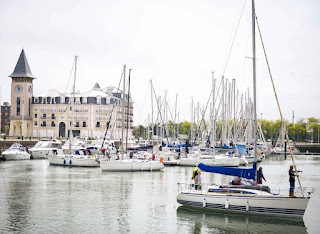
Port de Plaisance (photo: Sabina Lorkin/Anibas Photography)

Grand Port Maritime du Havre - The Port of Le Havre consists of a series of canal-like docks and multiple terminals for different types of cargo such as container ships and cruise liners. Cruise Terminal (Pointe de Floride) - In addition to being an important, cargo port, several major cruise lines stop in Le Havre, including: MSC Cruises, Norwegian, Royal Caribbean, Cunard, Oceania Cruises, etc. Port de Plaisance - There is also a marina.

Tour the Port of Le Havre:
Vedettes Baie de Seine (Tour in French) – This boat tour of the port is fascinating, even if you don’t speak French. Port Center (Tours in French; in English, request in advance + additional fee) – Offers various tours of the port by bus (autocar).

Tour Le Havre in Other Languages:
There are so many interesting sights. If you don’t speak French, there are great
Guides (guide conférencier) who speak English & other languages (i.e., German, Spanish, Italian, etc.) such as the terrific Anne-Charlotte Perré.
Inquire at: the Patrimoine office: Tel: +33 2 35 22 31 22;
maison-patrimoine-info@lehavre-etretat-tourisme.com

Or the Tourism office: Le Havre Etretat Normandie Tourisme
186 Blvd Clemenceau; Tel: +33 2 32 74 04 04


ART IS EVERYWHERE: FROM IMPRESSIONIST TO CONTEMPORARY
Many art historians believe that Impressionism originated in Le Havre as it was here in 1872 that Claude Monet painted his famous Impression, Sunrise which gave its name to the whole art movement. Monet’s mentor, the artist Eugène Boudin, introducing him to en plein air (in the open air) painting--working outdoors rather than in a studio. In 1858, when Monet was just 18 years old, Boudin coaxed him to paint the nature around them--clouds, sun, the seashore--and the way objects changed according to the fluctuating daylight. This plein-air style was also an inspiration to many future generations of artists.

Claude Monet, Impression, Sunrise (1872) 
Musée d’art Moderne André Malraux (MuMa) – Art Museum
2 Blvd Clemenceau, https://www.muma-lehavre.fr
The museum has the second-largest Impressionist collection in France. It was the first museum rebuilt after World War II, inaugurated by famous author & then Minister of Culture, André Malraux, in 1961. There are paintings by Monet, Pissarro, Renoir, Degas, Courbet, Braque, Eugène Boudin, Sisley, Van Dongen, Matisse, Marquet, Dufy, Friesz, Derain. You can also enjoy a tasty meal in the museum restaurant, Les Fauves.

Street Art - Self-Guided Tour
Back in 2017, to celebrate the 500th anniversary of the founding of the city and the Port of Le Havre, there was a festival, Un Été au Havre, that has become an annual event. At the first fest, international artists were invited to create large-scale art installations. Every year since, new works of art have been added, gradually transforming the city into an open-air, contemporary art exhibit.

Stop by an Art Gallery: Galerie Éric Baudet (121 Avenue Foch, https://galerie-ericbaudet.fr) – Modern & contemporary art.

NATURE IN-TOWN: THE BEACH, PARKS & GARDENS
Parks & Gardens: During the rebuilding of Le Havre and the port’s renewal, the inclusion of green spaces was paramount. Hence, there are splendid parks, gardens and woodlands throughout the town. Enjoy a stroll through: Square Saint-Roch, Les Jardins Suspendus (Hanging Gardens); Parc de Rouelles, Parc Forestier de Montgeon, and more. 
Head to the Beach - La Plage
La Plage, Le Havre

All you have to do to get to the beach in Le Havre is hop on a tram (A&B, Last stop: La Plage). Then, stroll along the promenade, get a snack from one of the many seaside eateries, enjoy some water sports or rent a lounge chair (May-Sept) and just relax. But, mind your tootsies, it’s a pebble beach, not sand.

Making Your Trip To Le Havre Easier:
- Le Havre Brochures & Maps (in French & English)
- Bee Le Havre: 1-hour city tour
- Visit Le Havre with a “Greeter” This is a lovely concept: locals share their favorite Le Havre spots with you for free!
Catène de Containers, Vincent Canivet 

Getting Around: Le Harve has a very efficient transport network (LiA) that makes travel easy between the city center and various places of interest. There are 2 tram lines (A/B), 21 bus routes, and a funicular (connects uptown to downtown), plus miles of bike paths (rent a bike, LiA Vélos). And, of course, taxis.
Where to Dine: No shortage of restaurants, brasseries, creperies, etc.
Chez André (9 rue Louis Philippe, www.restauration-chezandre.fr- For a truly, delicious meal, give this one a try.
Where To Stay: There’s every type of accommodation imaginable.
Hotel Vent d’Ouest (4 Rue de Caligny; https://www.ventdouest.fr/en) - A charming, 4-star boutique hotel & spa with a very-friendly staff in an excellent location.
Getting There: The Normandy region has its own train lines NOMAD; Paris - Gare Saint Lazare, direct to Le Havre (2 hours). Ferry from England: Portsmouth – Le Havre (8 hours) 
Nearby Jaunts: Visit other lovely towns along the Côte d'Albâtre. Normandy also has its own bus lines (NOMAD autocar): Ligne 509 connects Le Havre - Etretat - Fécamp. From Fécamp to Dieppe (Ligne 513, then 514).
***
Going Green: The Normandy region encourages “green” travel with some unique offers:
Le Tarif bas-carbone (Low-Carbon Rate) – Get 10% off at various attractions by showing your train or bus ticket, or a photo of your bike! Sejours bas-carbone (Low-Carbon Visits) – Suggestions of places to visit that are easy to get to (& get around) without a car. If you really want to drive, rent an electric car! Explore Normandy Pass – Discounts throughout the region.
Claude Monet - 2026 marks the 100th anniversary of his death; there’ll be lots of special exhibits in Normandy.


Sunday, June 7, 2026

Explore France’s Normandy Coastline, Côte d'Albâtre: Part ll: FÉCAMP: 5 Great Reasons To Visit

Fécamp (photo: Thomas Le Floc'H)


By Jacquelin Carnegie
There are so many reasons to explore France’s Normandy coastline: The Côte d’Albâtre (Alabaster coast) is a stretch of chalk cliffs, like England’s white cliffs of Dover across The Channel, with several worthwhile stops along the way.
Fécamp is a charming place to vacation; a lovely, relaxing spot with lots of interesting sites because…it was once a coastal base for the Dukes of Normandy in the 11th century and the locale of an important Benedictine Abbey during the early Middle Ages. Also, over the centuries, Fécamp became France’s top cod fishing port and today you can enjoy a meal of freshly-caught fish at the Marché aux Poissons as well as in almost every restaurant in town!

THREE MUST-SEE SITES
Les Pêcheries - Musée de Fécamp
3 Quai Capitaine Jean Recher; www.musee-fecamp.fr (Open daily, Fee)
Crinolines sur la plage, Fécamp, Jules Achille Noel, 1871; Les Pêcheries
Housed in a former 1950’s cod-drying factory, Les Pêcheries is actually several museums combined into one, all related to the history of Fécamp: First, the museum presents a comprehensive idea of the local way of life over the centuries. Next, it details the history of cod and herring fishing, the most important commercial activity in the area since ancient times. (The Fécamp fishermen ventured as far north as the Canadian coast of Newfoundland to catch cod.) Then, there’s a collection of fine art paintings reflecting the sights, history and events pertinent to the area. Plus, a fascinating exhibit devoted to a local doctor, Dr. Léon Dufour, whose innovations in the 19th century saved the lives of infants worldwide. Last-but-not-least, on the top floor, there’s a 360° view of the surroundings: town, sea, and cliffs.

Palais Bénédictine
110 rue Alexandre Le Grand; www.benedictinedom.com (Open daily, Guided tour, Fee)
Palais Bénédictine

Even if you don’t drink or have any interest in liqueur, this is a must-visit. The Benedictine Palace is an architectural delight of neo-Gothic and neo-Renaissance inspiration, built at the end of the 19th century with finely-decorated rooms, stunning stained-glass windows, and carved-wood walls.
Legend has it that in the Middle Ages a Benedictine monk came up with the recipe for a digestive based on 27 medicinal herbs and spices. The recipe was lost over time and only rediscovered in 1863 by a wine merchant from Fécamp, Alexander Le Grand. Monsieur Le Grant made Benedictine liqueur into a worldwide brand and built this amazing “palace” to house the only Benedictine distillery in the world as well as his eclectic collection of objects d’art. At the end of the tour, you also get to taste this unique liqueur.

Abbatiale de la Sainte Trinité - Abbey of the Holy Trinity of Fécamp
10 rue des Forts (Open daily; April-Sept 9am-7pm; Oct-March, 9am-12pm/2-5pm; Free to visit; Guided tour in French, Fee)
Fécamp Abbey
From the 11th century onwards, Benedictine monks settled here at the invitation of the Dukes of Normandy as it had been a holy site for centuries and one of the first pilgrimage locations in Normandy. The Fécamp Abbey is an impressive Gothic structure (127 meters/417 feet long), almost the same length as the Notre-Dame Cathedral in Paris (128 meters/420 feet) with interior adornments of interest from several centuries, such as: the Tabernacle of the Precious Blood, the 15th-century sculpture of the Dormition of the Virgin, and the magnificent 17th-century, Astronomical clock displaying: time, moon phases, and the tides.

OTHER ACTIVITIES TO ENJOY
The Great Outdoors: There’s every kind of enjoyable, outdoor activity imaginable in this bucolic spot: hiking, biking, horseback-riding, sailing and, of course, just relaxing on the beach. Plus, several interesting Guided Tours (Tours in French; in English only for groups in case you’re traveling with many friends &/or your whole family in tow). Check with the tourism office for all the options: Fécamp Tourisme (Quai Sadi Carnot, Tel: +33 2 35 28 51 01) 
On the Beach, Fecamp, Berthe Morisot, 1873

Marché aux Poissons 
(2 rue du Commandant Riondel; Seasonal Opening hours: Fri & Sat, 9am-12:30pm/3pm-7pm; Tues-Thurs, 9am-12:30pm)
- Enjoy a freshly-caught, seafood meal at the Marché aux Poissons (fish market). Depending on the time of year, the best catch might be: cod, sole, bream, smoked & salt-cured herring (Oct-Jan), scallops (Oct-May), mackerel (summer), mussels, oysters, whelks & clams.

A LOVELY DAY TRIP
ÉTRETAT: This lovely, little village--known for its falaises, steep cliffs facing the sea, and rock arches (Aval, Amont & Manneporte)--has appealed to artistic types for centuries, such as writers (Guy de Maupassant, Victor Hugo, Gustave Flaubert, etc.) and painters (Claude Monet, Gustave Courbet, Eugène Boudin, etc.). Today, it’s just as inviting. Enjoy the landscape & these two worthwhile sites:
Les Jardins d'Étretat (Ave Damilaville; https://etretatgarden.fr; Closed: Dec-Feb; Fee) - Landscape architect Alexander Grivko transformed the grounds of a Belle Epoque villa into a magnificent, cliffside, topiary garden that features knock-out, contemporary art. Twice awarded the prestigious “Remarkable Garden” label by the French Ministry of Culture.
Les Jardins d’Étretat (photo: Yann Monel)

Clos Lupin – Maison Maurice Leblanc 
(15 rue Guy de Maupassant; Tel: +33 2 35 10 59 53; Fee)Visit if you’re a fan of Leblanc’s books about the gentleman burglar, Arsène Lupin.
Dine: Restaurant du Perrey (3 rue Général Leclerc) – After sightseeing, enjoy a delicious meal with a spectacular view right on the waterfront. 
Getting to Étretat: From Fécamp or Le Havre by bus (autocar), Ligne 509
Or, from Fécamp, take a 2-hour speed boat excursion, La Mer pour Tous, or a 4-hour mini-cruise on a sail boat.

Making Your Trip to Fécamp Easier:
Where To Dine: Many good restaurants in town to choose from, plus the Marché aux Poissons.
Where To Stay: Absolutely all kinds of nice accommodations.
Hôtel Le Grand Pavois (15 Quai de la Vicomte; https://www.hotel-grand-pavois.com/en) - Nice, modern hotel in a great location, right on the harbor.
Getting around: In-town the Fici Bus. Fécamp Brochures & Maps (in French & English).
Fécamp harbor
Getting There: The Normandy region has its own train lines NOMAD; Paris - Gare Saint Lazare, change at Bréauté–Beuzeville for Fécamp (about 2 1/2hrs) 
Bus: FLIXBUS – Paris direct to Fécamp (around 3hrs)
Nearby Jaunts: Visit other lovely towns along the Côte d'Albâtre. Normandy also has its own bus lines (NOMAD autocar): Ligne 509 connects Fécamp - Etretat - Le Havre. From Fécamp to Dieppe (Ligne 513 to St Valéry en Caux, then 514 to Dieppe).
***
Going Green: The Normandy region encourages “green” travel with some unique offers: Le Tarif bas-carbone (Low-Carbon Rate) – Get 10% off at various attractions by showing your train or bus ticket, or a photo of your bike! Sejours bas-carbone (Low-Carbon Visits) – Suggestions of places to visit that are easy to get to (& get around) without a car. If you really want to drive, rent an electric car! Explore Normandy Pass – Discounts throughout the region.
Parc Éolien - France’s first Offshore Wind Farm in Normandy, is off the coast of Fécamp; you can see it on a boat tour.
Claude Monet2026 marks the 100th anniversary of his death; there’ll be lots of special exhibits in Normandy.


Sunday, May 31, 2026

Explore France’s Normandy Coastline, Côte d'Albâtre: Part lll: DIEPPE: 5 Great Reasons To Visit

By Jacquelin Carnegie
Eugene Boudin On the Beach, Dieppe (1864)
There are so many reasons to explore France’s Normandy coastline: The Côte d’Albâtre (Alabaster coast) is a stretch of chalk cliffs, like England’s white cliffs of Dover across The Channel, with several worthwhile stops along the way.
Dieppe is considered France’s very first seaside resort and has the prestigious Ville d’Art et d’Histoire (“Town of Art & History”) label awarded by the French Ministry of Culture. It also has some of the best seafood restaurants along the coast!

A LOVELY SEASIDE TOWN
In the 19th century, the upper classes became preoccupied with their health. By mid-century, physicians began touting the medicinal benefits of fresh air, exercise, and sea bathing. European elites beat a path to the beach, making villes balnéaire (seaside towns) and “sea cures” all the rage.
Dieppe is considered France’s very first seaside resort as sea bathing began here as far back as 1822. In 1824, the famous Duchesse de Berry, daughter-in-law of King Charles X, arrived and turned it into a trendy locale. The British crossed The Channel by ferry and, in 1848, a railway line connected Paris to Dieppe and Parisians started to flock to town. Today, Dieppe is still a popular seaside resort. You can relax on the Plage de Dieppe, a long, pebble beach, stroll along the lovely esplanade, and stay at nice hotels right by the shore.
Kite Festival (photo: David Parry)

Festival International de Cerfs-Volants - Kite Festival (every 2 years, next one Sept 2027) – An exciting event that fills the sky over the beach with delightful shapes & colors!

A HAVEN FOR ARTISTS & WRITERS
In the 19th century, the fashionable seaside resort of Dieppe, also became popular with writers--attracted by its’ vibrant, Bohemian scene--and artists--enticed by its unique atmosphere and quality of light--that inspired them to paint the lively port and lovely beachfront with its dramatic cliffs.
Well-known artists such as J.M.W. Turner, Claude Monet & Camille Pissarro came here to paint. Others such as the German-British artist Walter Sickert came here to live. Famous writers such as Oscar Wilde & Guy de Maupassant came here to hang out.
Dieppe Office de Tourisme (Pont Jehan Ango; Tel: +33 2 32 14 40 60)
Take a fascinating tour of all the sights that inspired the painters & writers, stroll through Le Pollet, the historic, fishermen’s neighborhood, and learn the history behind the churches Église Saint-Jacques & Église Saint-Rémy.
a) Do self-guided, walking tours with the aid of these maps or b) The Tourism Office can arrange a guide such as Bertrand Edimo from the Dieppe Ville d’Art et d’Histoire office. (Tours in French, English, Spanish & German.)
Dieppe Harbor (photo: Lezbroz/Dieppe-Normandie Tourisme)

Château-Musée de Dieppe
(Rue de Chastes; Open: Feb-Dec, Wed-Sun, 10am-6pm; Fee)
Head up a steep hill to the fortress-castle museum, the Vieux-Château, rebuilt in 1435, houses the city’s maritime heritage and one of the finest collections of carved ivories in Europe. There are also Impressionist paintings by famous artists such as Renoir & Pissarro, and a room devoted to French composer Camille Saint-Saëns. Plus, great views over the town.

A GREAT PLACE TO DINE: SEAFOOD & LOCAL SPECIALTIES
After all, Dieppe is a fishing port and, over the centuries, herring and scallops have been two important catches for the community. In fact, Dieppe is France’s leading port for this exceptional shellfish (Coquille Saint-Jacques = scallops).
Fish Market (photo: Paul Grecaud)
Foire aux Harengs et à la Coquille Saint-Jacques - Herring & Scallop Festival (3rd weekend in November) – Not only seafood, but a town fair with entertainment & parades.
Local Specialties: Marché de Dieppe
(Saturday, 8am-1pm) - This Saturday-morning market was voted Plus Beau Marché de France (“Most Beautiful Market in France”). Some 200 vendor stalls run the entire length of the pedestrian street, the Grande Rue, right up to the Place du Puits-Salé, and along the side streets as well. Pick up some mouth-watering, local specialties such as Neufchâtel cheese, apple caramel spread, and cider. Fish, seafood, organic fruits & veggies, spices, and household items.

Dining & Drinks: Most of the chefs for Dieppe’s many, fine restaurants, pick out the freshest catch-of-the-day at the Marché aux Poissons.
Le Bas Fort Blanc (Photo: Khris Passenaud)
Bistrot des Barrières (5 Arcade de la Poissonnerie; Tel: +33 2 35 40 46 83- The most delicious dishes of freshly-caught, local seafood served along with organic fruits & vegetables from a nearby farm. Everything is expertly-made in-house, including the bread.
Le Bas Fort Blanc (10 Rue Alexandre Dumas; Tel: +33 2 35 06 01 36) - Right on the ocean with stunning views, a large outdoor patio & indoor dining. Tasty, fresh-seafood offerings, great drinks, and fancy desserts.
Café des Tribunaux (Place du Puits Salé) - This historic place is best for drinks on the café terrace where Oscar Wilde and Guy De Maupassant used to hang out.

SPORTS GALORE: A GREAT PLACE TO HIKE & BIKE
In addition to all the fabulous watersports (surfing, sailing, kayaking, paddleboarding, etc.), you can go on local hikes and bike rides or do something a little more ambitious…
Sailing (photo: Ville de Dieppe)

Hiking Trail, GR21 – This is a long-distance, hiking trail that goes along Normandy’s Côte d'Albâtre. You could hike all the way from Le Havre to Dieppe and on to Le Tréport or just do smaller segments. 
3 Biking Routes: If you don’t have a bike, there are plenty of places to rent one.
1) Vélomaritime (EuroVelo 4) - This biking route goes along Normandy’s coastline. Instead of hiking, you could bike all the way from Le Havre to Dieppe and on to Le Tréport.
2) Véloroute du Lin - This is a lovely bike route through the countryside between Dieppe and Fécamp.
3) Avenue Verte - How ambitious are you? Bike all the way from Paris to Dieppe (& on to London via a ferry segment).

A LOVELY DAY TRIP
VARENGEVILLE-SUR-MER: Close to Dieppe, this lovely, little town has been a favorite spot for musicians, writers, and artists: the Impressionists Monet, Renoir, Pissarro, Corot and the Cubist artist Georges Braque, who became a resident, Surrealist painter Joan Miró and the Modernist sculptor Alexandre Calder. It’s as alluring today and worth a visit, especially for these two spots:
Église Saint-Valéry, marine cemetery
(photo: Mairie de 
Varengeville-sur-Mer)

Église Saint-Valéry (43 Rte de I’Église) – Perched atop the Ailly cliff, the church was originally built in the 12th century by Conches Abbey monks and enlarged in the 16th century. The interior is now adorned by modern art, notably stained-glass windows by Georges Braque and his student Raoul Ubac. Braque is buried in the church’s “sailors cemetery”; he designed his own gravestone, a mosaic of a bird in flight.
Musée Michel Ciry 
(6 bis rue Marguerite Rolle; https://www.museemichelciry.com Open: May-Sept, Wed-Mon, 2-6pm; April & Oct, weekends, 2-6pm; Fee) - Michel Ciry was a French painter, composer, and writer born in Brittany in 1919. He was known foremost as a master engraver and illustrator, but he did work in various mediums such as oil, watercolor, and ink. In 1964, he moved to Varengeville-sur-Mer where he lived until his death in 2018. In 2012, he created a museum to present a permanent collection of his work. A devout Christian, his art is largely devoted to sacred themes, but he also did lovely landscapes and touching portraits. Built next to his former farmhouse home, the museum is a stunning, modern structure that has space for temporary exhibits by other artists and offers cultural events such as concerts and readings, in tribute to his other achievements in music and literature.
Getting There: From Dieppe to Varengeville-sur-Mer, take bus (NOMAD autocar) Ligne 514 (around 1/2 hour); for another interesting visit, continue on to Veules-les-Roses (named one of the Most Beautiful Villages of France “Les Plus Beaux Villages de France”). 

Making Your Trip to Dieppe Easier:
Tourisme Pass (July-Sept; Fee) – Provides entry to many monuments & activities. 
Where To Stay: All kinds of accommodations to choose from, including those on the seafront. 
Michel Ciry Le Tréport 1976

Hôtel Aguado (30 Blvd de Verdun, https://www.hoteldieppe.com) - Family-run for 3 generations, the hotel offers the best of both worlds: it overlooks the sea & is also smack-dab in the middle of town, close to all the sights, shops & restaurants.
Getting Around: There’s a free shuttle bus that makes a loop around town from the train station to the beach & regular bus routes, DeepMob.
Petit Train de Dieppe (Feb-Nov; Fee) – Many French towns have a little, tourist train; a 45-minute loop of all the important sights. 
Getting There: The Normandy region has its own train lines NOMAD; Paris - Gare Saint Lazare, with a connection in Rouen to Dieppe (2 1/2 hours). 
Bus: FLIXBUS – Paris direct to Dieppe (around 3 hours)
Ferry from England: Newhaven – Dieppe (4 hours) 
Nearby Jaunts: Visit other lovely towns along the Côte d'Albâtre. Normandy also has its own bus lines (NOMAD autocar): From Dieppe to Fécamp (Ligne 514 to St Valéry en Caux, then 513). Ligne 509 connects Fécamp - Etretat - Le Havre.
***
Going Green: The Normandy region encourages “green” travel with some unique offers: Le Tarif bas-carbone (Low-Carbon Rate) – Get 10% off at various attractions by showing your train or bus ticket, or a photo of your bike! Sejours bas-carbone (Low-Carbon Visits) – Suggestions of places to visit that are easy to get to (& get around) without a car. If you really want to drive, rent an electric car! Explore Normandy Pass – Discounts throughout the region. Claude Monet - 2026 marks the 100th anniversary of his death; there’ll be lots of special exhibits in Normandy.


Wednesday, August 21, 2024

Côte Fleurie: Cabourg & Honfleur, France – Proust & Impressionist Painters

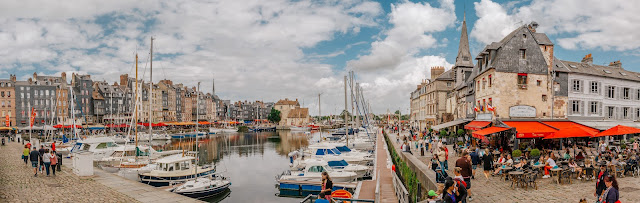
Honfleur, Vieux Bassin ©SMA76T.LeMassonBanningLover


By Jacquelin Carnegie
HONFLEUR: SOAK IN THE BEAUTY
“A ravishing port full of masts and sails, crowned with green hills and surrounded by narrow houses”--this is how the famous author Victor Hugo described Honfleur in the 19th century--and it’s still so today.
Honfleur is another truly-lovely town on Normandy’s “Côte Fleurie” (Flowery Coast) that has been a favorite of artists for centuries. Spend some time in the heart of town admiring the Vieux Bassin (old harbor), lined with 16th- to 18th-century houses, and you’ll understand why.
Have a plateau de fruits de mer (seafood platter) at one of the charming cafés. Try some local, apple-brandy Calvados and delicious Normandy cheeses. Then, stroll along the winding, cobblestone streets stopping into quaint shops and art galleries. But, be sure to visit these sites:

An Inspiration To Artists
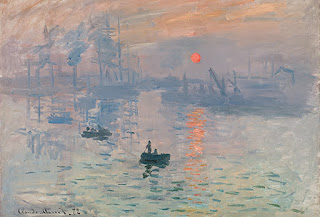
Claude Monet, Impression, Sunrise (1872)
Musée Marmottan

It’s thought, among many art historians, that Impressionism originated here. The artist Eugène Boudin, born in Honfleur, was Claude Monet’s mentor, introducing him to en plein air (in the open air) painting--working outdoors rather than in a studio. In 1858, when Monet was just 18 years old, Boudin coaxed him to paint the nature around them--clouds, sun, the seashore--and the way objects changed according to the fluctuating daylight. Boudin’s plein-air style was also an inspiration to many future generations of artists who flocked to Honfleur from Georges Seurat, the founder of Neo-Impressionism (Pointillism), in 1886 to Raoul Dufy in 1928, who credits Honfleur as the place he found his own, true painting style.

Musée Eugène Boudin
Place Erik Satie; https://tinyurl.com/54bry8bk
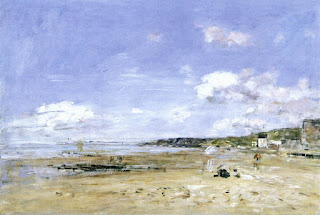
Eugène Boudin, Summer at Trouville (1890-94)
Musée Malraux Le Havre

Honfleur, the inspiration for Impressionist and pre-Impressionist masters such as JMW Turner, Jean-Baptiste-Camille Corot, Gustave Courbet, Édouard Villard, Johan Jongkind, and Claude Monet, was also the birthplace of Eugène Boudin.
This lovely museum houses a splendid selection of Boudin’s artwork along with a collection of paintings of Honfleur and the Normandy coast done by other prominent, 19th- and 20th-century artists. There are also displays of vintage photographs, tourism posters, antiques, and changing, temporary exhibits.

Maisons Satie
67 Blvd Charles V; https://tinyurl.com/p73p9y8r
Maisons Satie ©Florian Vimont

Honfleur is also the birthplace of Erik Satie, an acclaimed, early 20th-century, avant-garde composer and musician. Satie worked with composers Debussy, Ravel, and Stravinsky as well as with artists and writers such as Picasso, Braque, Cocteau, and filmmaker René Clair. The museum provides a whimsical, surreal way to experience his art and music collaborations.

Église Sainte-Catherine
Place Sainte-Catherine
©OTC Honfleur

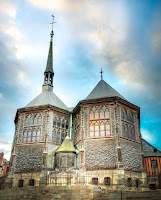
St. Catherine's is such a unique church. Constructed by shipbuilders in the 15th century, it’s made entirely of wood. The interior resembles the hull of a ship with many decorative, nautical details. It’s thought to be the largest, wooden church in France.

Being There:
Eat: Lots of great places to eat
(try the oyster bar Entre Terre et Mer).
Stay: There’s everything from B&Bs to luxury hotels.
Cruises: The Seine River meets the sea at Honfleur, so it’s a port-of-call for both riverboats and small, ocean liners. If you enjoy cruising, it’s one way to get here. However, as beautiful as Honfleur is, on the days the cruises arrive, the town is often overrun with tour groups. If you find this a bother, check cruise dates with the Honfleur Tourism office, so you don’t arrive when they do. 
***

CABOURG: THE BELLE ÉPOQUE COMES TO LIFE
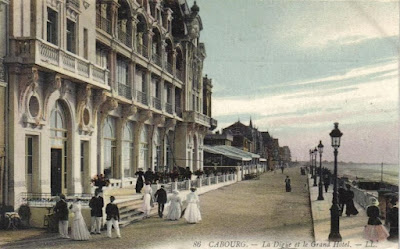
Famed author Marcel Proust vacationed in Trouville in his younger days. But, when his pals in Paris’ social circles moved on to Cabourg, another magnificent seaside resort on the Calvados coast, so did he.
During the Belle 
Époque, Proust summered in Cabourg from 1907 to 1914, drawing inspiration for his literary masterpiece, the seven-volume, À la Recherche du Temps Perdu (In Search of Lost Time).

La Villa du Temps Retrouvé
15 Ave du Président Raymond Poincaré; villadutempsretrouve.com
(Open: March-Nov; Guided tours are offered in French & English)
La Villa du Temps Retrouvé

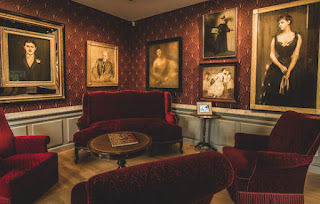
While the Belle Époque era (1870-1914) is over, you can experience what it must have been like with a visit to this marvelous house-museum. The rooms’ décor evokes the style of living that Marcel Proust and his pals (and his novel’s characters) would have been accustomed to. Through the Villa du Temps Retrouvé’s immersive experience, you get insight into Proust’s creative process and his sources of inspiration from paintings and photographs to books and music, to period furnishings and objets d'arts. And, with the use of innovative technology, Proust’s world comes to life. It’s a nice way to journey back in time to France’s “Beautiful Age” on the Côte Fleurie and to learn about the artistic and intellectual circles of the Belle Époque.

Grand Hôtel de Cabourg
Les Jardins Du Casino; www.grand-hotel-cabourg.com
(photo: JCarnegie)

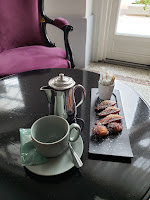
From 1907 to 1914, Marcel Proust spent his summers here in Room 414. In Volume II of À la Recherche du Temps Perdu (In Search of Lost Time), À L'Ombre des Jeunes Filles en Fleur, the seaside resort “Balbec” is none other than Cabourg. The narrator of the novel stays here with his grandmother for the summer—doesn’t that sound nice? Splurge and stay here yourself. Or, if that’s out of the budget, at least stop by for tea. Try the hotel’s special: “Le Gouter Proustien” (tea with madeleines).

Getting There:
To get to Cabourg &/or Honfleur, take the fast train (TGV) from Paris to the Trouville-Deauville train station (2hrs). Then, a taxi, Central Taxis Deauville (+33 2 31 87 11 11), about 20 mins in either direction. Or, a bus, NomadCar Bus #20, to Cabourg or Honfleur (about 30 mins). Or, drive. It’s around 2 hours from Paris to Cabourg/Honfleur on Autoroute A13 or meander along discovering other lovely areas of the Normandy region on the way. 
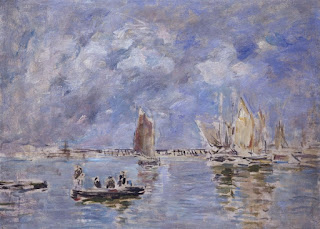
Eugène Boudin, Boats and Breakwater, (1890-97)
Musée Malraux Le Havre
Nearby Jaunts:
Visit all the towns along the “Côte Fleurie” Calvados coastline such as Deauville & Trouville. And, while in the Calvados area of Normandy, perhaps visit a distillery or do the Calvados Expérience in Pont-l’Evêque. (Pont-l’Evêque is also the name of a famous Normandy cheese which you can buy in the area or, if curious, tour a cheese maker, Fromagerie E. Graindorge.)

Wednesday, August 7, 2024

Côte Fleurie: Deauville, France - Glamour, Horse Races, Fashion & Film

By Jacquelin Carnegie
Deauville Beach (photo: Béatrice Augier/inDeauville)

Deauville is a beautiful, ritzy, seaside resort on Normandy’s “Côte Fleurie” (Flowery Coast). It’s been an upscale, holiday destination since the 1860s, when Dr. Joseph Olliffe, a physician to the French & British upper class, along with his pal, the Duke of Morny (Napoleon III’s half-brother), basically put Deauville “on the map” with the help of their rich, investor-friends. 
Life’s A Beach: It’s amazing what vision paired with money and influence can produce. In a few short years a railway line from Paris was laid. Grand hotels were built. Swank beach-bathing facilities were installed and posh horse races began. In 1911, a grand casino was built. In 1923, the Promenade des Planches, the now-famous, wooded
(photo: Delphine Barré Lerouxel/inDeauville)
boardwalk paralleling the seaside, was created. Deauville became one of the most prestigious seaside resorts in France, and has remained fashionable to this day.
But, while posh Parisians still come for the sporting life and chic boutiques, the horse races cost only a few Euros, the American Film Festival is open to the public, and the beautiful, wide, sandy beach is accessible to everyone.

THE RACING LIFE
Hippodrome de Deauville-La Touques (Racetrack)
45 Ave Hocquart de Turtot
Hippodrome (photo: Scoopdyga/inDeauville)

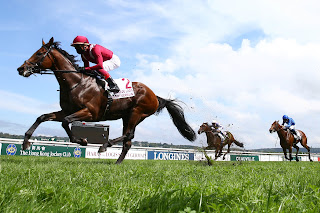
Since it opened in 1864, the Hippodrome has attracted the top international trainers and jockeys, and an elite clientele to watch the crème-de-la-crème of racehorses run. But any horse-racing enthusiast can enjoy some 40+ regular races throughout the year as the tickets are only a few Euros. (It’s even possible to place a bet, if you know how to pick’em.) There’s also a second track Deauville-Clairefontaine (Route de Clairefontaine) and a renowned training center. If you prefer polo matches, some of the world’s best teams play here in August as the Deauville International Polo Club, founded in 1907, is one of the oldest in France. Before the renowned Deauville-La Touques racetrack was built--thanks to the Duke of Morny--horse racing took place on the beach. The horses are still brought here at dawn & dusk for workouts as the sea water is good for their legs.

SHOPPING IN FASHION
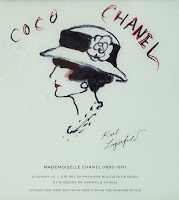
The town is chock-a-block with high-end, luxury stores such as Hermès, Louis Vuitton, and Ralph Lauren. This is fitting as Coco Chanel opened her first clothing boutique here in 1913. Brought to Deauville by Boy 
Capel, her English, polo-player
beau, Chanel admired the fishermen’s mariniere (striped shirts) and the polo players’ knit-jersey sweaters. To stay warm and comfy, she borrowed clothing from Capel--a striped shirt, a knit sweater, a pair of pants--causing a sensation. But, she was sure that other women visiting the resort area would want comfortable clothing, too. Chanel then designed a line of prêt-à-porter, loose-fitting, knit garments; basically, launching a new clothing category: “chic sportswear.” The rest is fashion history and it all started here.

CULTURAL CONNECTIONS
Les Franciscaines
145 B Ave De La République; lesfranciscaines.fr
Les Franciscaines (photo: Moatti-Riviere)


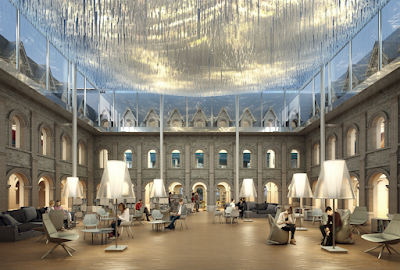
It’s worth coming to France just to experience Deauville’s newest cultural center--Les Franciscaines. Housed in a magnificent building that once was a Franciscan convent, the beautifully-restored facility is now a unique combo of: museum, library, médiathèque, snack bar, cinema, lecture hall. In short, the absolute, coolest place you’ve ever hung out. The architectural makeover is stunning, the décor is sublime—each area is color-coordinated and theme-related. Oh, yeah, there’s an art collection of over 500 paintings. And, temporary exhibits, and photos. Also, workshops for kids & adults. Or, you can just sit there and read a magazine. Either way, you won’t want to leave.

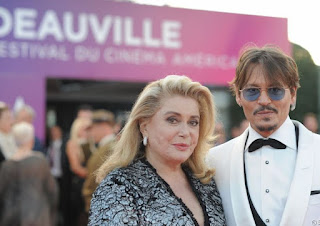
Deauville American Film Festival (Sept)
Johnny Depp/Catherine Deneuve
(photo: Deauville American Film Festival)

This prestigious festival began in 1975 to promote American cinema and attract American and European screen stars to the area. 24/7 Screenings: Over the ten days, film screenings are held 24 hours a day. There are several categories such as: “Premieres” - screenings followed by Q&As with the creators; “Competition” - presenting indie films; “Uncle Sam’s Docs” - documentaries about American life; & “Window on French Cinema.” (Get a Day or Festival Pass to see great cinema and lots of celebrities!)

LIFE IS GRAND
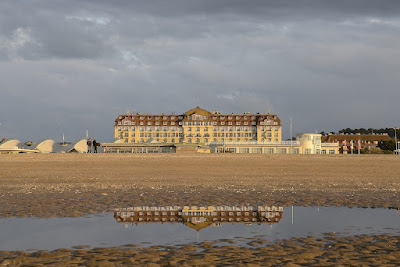
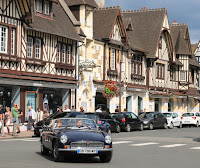
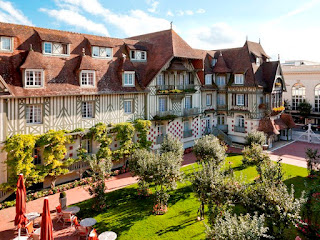
In 1912, to continue attracting chic Parisians and British high society, Deauville opened two Grand hotels in the Normandy, timber-frame style: Hôtel Barrière-Le Normandy Deauville (38 Rue Jean Mermoz) and Hôtel Barrière-Le Royal Deauville (Blvd Cornuché BP). These lovely, luxury hotels continue to welcome an international, elite crowd along with movie stars and other celebrities. It’s worth
Le Normandy (photo: Group Barrière)
the splurge to stay at one of them but, if not in the budget, just come by to enjoy a delicious, afternoon tea or evening cocktail; sit in the lounges and gawk.
Right between the two hotels is the Casino Barrière de Deauville (2 rue Edmond Blanc). You can tempt “lady luck”, but you don’t have to be a gambler to spend an evening here. There’s an elegant, little theatre--a replica of the Petit Trianon at Versailles--where classic & contemporary dance, concerts, musicals, and even one-man shows are performed.

Other Sports Activities:
For duffers, there are world-class, golf courses such as the Golf Barrière Deauville & the Amirauté Golf. For swimmers or just anyone who enjoys a soak without having to go into the ocean, there’s the Piscine Olympique de Deauville (Blvd de la Mer). Two pools filled with heated, purified sea water. Like spending a day at a spa at a fraction of the cost. There’s also great sailing.
Porte Bassin Morny (photo: Naiade Plante/inDeauville)

Where To Stay: In addition to the aforementioned Grand hotels, there’s a range of accommodations to select from in Deauville and the surrounding area.
Getting There: Take the fast train (TGV) from Paris to the Trouville-Deauville train station (2hrs). Or, drive. From Paris to Deauville, it’s around 120 miles/194 km (2hrs) on Autoroute A13 (with tolls) or meander on back roads discovering other lovely areas of the Normandy region along the way.
Nearby Jaunts:
The “Côte Fleurie” is a succession of lovely towns on long, sandy beaches along the coastline of the Calvados area in the Normandy region. Visit all the towns such as Trouville, Honfleur & Cabourg.